In silico neutron relative biological effectiveness estimations for pre-DNA repair and post-DNA repair endpoints
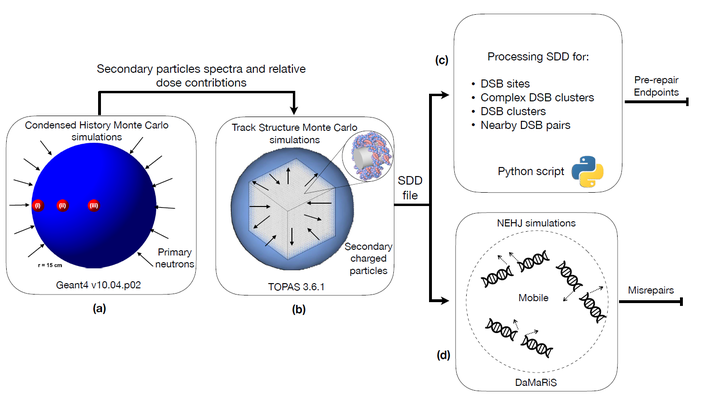 Image credit: John Kildea
Abstract
A comprehensive understanding of the energy-dependent stochastic risks associated with neutron exposure is crucial to develop robust radioprotection systems. However, the scarcity of experimental data presents significant challenges in this domain. Track-structure Monte Carlo simulations with DNA models have demonstrated their potential to further our fundamental understanding of neutron-induced stochastic risks. To date, most track-structure Monte Carlo studies on the relative biological effectiveness (RBE) of neutrons have focused on various types of DNA damage clusters defined using base pair distances. In this study, we extend these methodologies by incorporating the simulation of non-homologous end joining (NHEJ) DNA repair in order to evaluate the RBE of neutrons for misrepairs. To achieve this, we adapted our previously published Monte Carlo DNA damage simulation pipeline, which combines condensed-history and track-structure Monte Carlo methods, to support the standard DNA damage (SDD) data format. This adaptation enabled seamless integration of neutron-induced DNA damage results with the DNA Mechanistic Repair Simulator (DaMaRiS) toolkit. Additionally, we developed a clustering algorithm that reproduces pre-repair endpoints studied in prior works, as well as novel damage clusters based on Euclidean distances. The neutron RBE for misrepairs obtained in this study exhibits a qualitatively similar shape as the RBE obtained for previously reported pre-repair endpoints. However, it peaks higher, reaching a maximum RBE value of 23(1) at a neutron energy of 0.5 MeV. Furthermore, we found that misrepair outcomes were better reproduced using the pre-repair endpoint defined with the Euclidean distance between double-strand breaks rather than with previously published pre-repair endpoints based on base-pair distances. The optimal maximal Euclidean distances were 18 nm for 0.5 MeV neutrons and 60 nm for 250 keV photons. Although this may indicate that Euclidean-distance–based DSB clustering more accurately reflects the DNA damage configurations that lead to misrepairs, the fact that neutrons and photons require different distances raises doubts on whether a single, universal pre-repair endpoint can used as a stand-in for larger-scale aberrations across all radiation qualities.

Nicolas Desjardins-Proulx
MSc Student