Reference radiation selection is confirmed as a significant source of relative biological effectiveness variation for neutrons
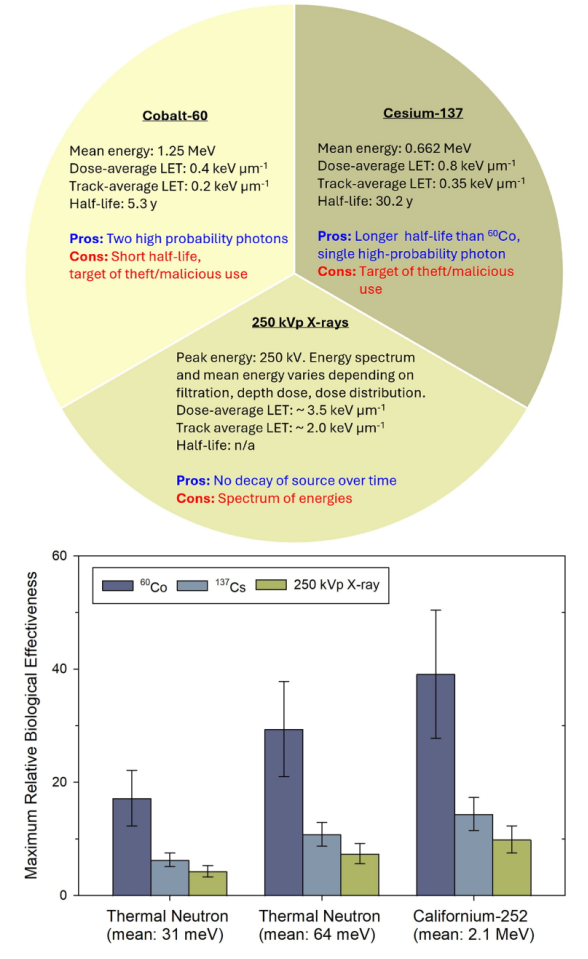 Image credit: Laura Paterson
Abstract
Purpose: To confirm that the selection of a reference radiation affects the magnitude and range of the relative biological effectiveness (RBE) evaluations of neutron test radiation. Particular attention was paid to the published thermal neutron RBE dataset that is highly variable, with values ranging from 5.4–51.1.
Materials and methods: This involved a dual approach of 1) reaffirming dicentric chromosome assay (DCA) dose-response curve differences for 60Co, 137Cs, and 250 kVp X-rays, and 2) recalculating maximum RBE at minimal doses (RBEM) for our previously reported neutron data, accompanied by an evaluation of reported studies that utilized two or more reference radiations.
Results and conclusions: The linear slope coefficient of the linear-quadratic dose-response curve, used to evaluate RBEM, was found to be significantly different for 60Co (0.0268 ± 0.0075 Gy−1) compared to 137Cs (0.0730 ± 0.0135, P < 0.01) and 250 kVp X-ray (0.1063 ± 0.0248, P < 0.01). Applying this finding to our previous thermal and fast neutron DCA evaluations, the RBEM varied by a factor of 2.7 for 60Co versus 137Cs, and by a factor of four for 60Co versus 250 kVp X-ray. A review of prior reported neutron RBEM literature affirmed the finding that reference radiation selection can influence RBEM magnitude. The selection of the reference radiation has implications for RBE evaluations of neutrons and other radiation qualities, as these RBE values underpin the radiation weighting factor, wR, which informs radiation protection measures both terrestrially and in space. These experiments and reanalysis reconfirm and strongly demonstrate that reference radiation selection is a significant determinant of RBE variability, especially as applied to neutrons.

Laura Paterson
PhD Student

Norma Ybarra
Assistant Professor, Collaborator on NICE radiobiology projects

John Kildea
Associate Professor (tenured) of Medical Physics